Sunday, October 22, 2006

Far Back and Afield

Returning to an earlier conversation about looking back and afield:

I receive several emails a day from e-Flux, a subscription service that sends out press releases for exhibitions all over the world. I get many I don't care about, but it's a great service because it's astounding how many exhibits are going on all of the time all over the place, plus it's the best way to be alerted to things I do care about but didn't know was happening. It's also the best way to read some of the most astoundingly asinine curator's statements with tremendous convenience. And it's also the best way to see who is hot, at least among curators- when you see Liam Gillick's name in at least one press release a week over a few months, you kind of wonder if he's really that great, or whether he's really cute or a great partier. I have no idea. Anyway, at the very least perhaps it's the art version of staring at the cover of People and Us while standing in the checkout line at the grocery store.

Maybe almost a couple of months ago I received an announcement for a soon to open show called High Times, Hard Times: New York Painting 1967-1975. The press release says:

High Times, Hard Times not only captures a tumultuous period of political and social change, but also reflects the impact of the civil rights struggle, student and anti-war activism, and the beginnings of feminism in the art world. Painting is the one element usually left out of this complex narrative, remembered only as a regressive foil to the various new mediums. But this version of the story greatly oversimplifies the situation, effacing painting that earned a place among the most experimental work of the moment, very much in sympathy with the era’s radical aesthetics and politics...

Artists in Exhibition
Jo Baer, Lynda Benglis, Dan Christensen, Roy Colmer, Mary Corse, David Diao, Manny Farber, Louise Fishman, Guy Goodwin, Ron Gorchov, Harmony Hammond, Mary Heilmann, Ralph Humphrey, Jane Kaufman, Harriet Korman, Yayoi Kusama, Al Loving, Lee Lozano, Ree Morton, Elizabeth Murray, Joe Overstreet, Blinky Palermo, Cesar Paternosto, Howardena Pindell, Dorothea Rockburne, Carolee Schneemann, Alan Shields, Kenneth Showell, Joan Snyder, Lawrence Stafford, Pat Steir, Richard Tuttle, Richard Van Buren, Michael Venezia, Franz Erhard Walther, Jack Whitten and Peter Young.


I instantly ordered the catalog, and I'm glad I did.

In 1976 I was attending a local community college, trying to figure out if I was going to go into journalism or art. Or something else. The short story about that is that I just kept doing what interested me and I did the art thing. It was like it was never really a question. I just followed myself.
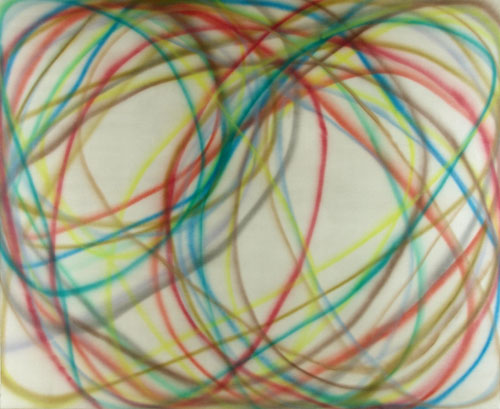


Dan Christensen: Pavo, 1968, Acrylic on canvas

I was a lousy student, and I still am, in the sense that I've never liked going to class, never liked the assignments, and have always learned best on my own, even if it takes my three times the amount of effort to learn something on my own. And I didn't want to learn about art by practicing perspective and making color charts. I liked drawing the figure, and I liked the studio classes because I could come late and leave early and do all of my work at home without anyone else around.

Once I discovered Abstract Expressionism, at age 18, and about twenty years too late, I found it hard to be engaged by much else except for the Bay Area figure painters like Diebenkorn and Park. But that's another story to tell, about how long it took me to not see art as a bunch of file drawers and a timeline, but rather as a large amoebic thing where painters from all eras have so much in common. And I had to figure that out on my own, too. But I did manage to figure out something about NY painting of the 60's and 70's, and it wasn't until I started thinking about High Times, Hard Times that I realize what an impact painting of that era had on me.

Somehow in that first year of college I figured out that the library had periodical stacks. I was already checking out books, but I didn't really know how to use a library and I didn't know anything about the treasure trove of material there. I can't recall how I figured it out, but I think I accidentally stumbled on the stacks while looking for one section in the library.
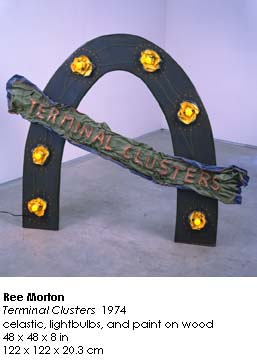


Source

I did what lots of art students did (do they still?): when I discovered the back issues of art magazines I started poring over them- Artforum, Art in America, Arts, Art News, Studio International, Kunst. There must have been others. And I started from the present day working backwards. And then I figured something else out- lots of books and articles in magazines have footnotes. If I was reading an article about Frank Stella in Artforum that referenced a Donald Judd review of Stella in Artforum five years earlier I could go read that. It was like reading a dialog. Amazing.

Beginning with 1976, I started working backwards through the magazine into the mid-sixties, reading articles and reviews. And when I saw the press release for High Times, Hard Times it just hit me- I know all of those artists, I like that work, and come to think of it, much of that stuff has been pretty important to me, even up until today. Steir, Gorchov, Tuttle, Benglis, Fishman, Young, Baer, Palermo- I think about that stuff. Work that might seem less relevant to me- Pindell, Loving, Lozano, Christensen, Schneeman- no, no, that stuff is great. All of that had a great imprint on me, and it comes out of a very interesting period that the catalog for the exhibition makes clear- political unrest, drugs, music, civil rights, assassinations- these events are part of the landscape of my adolescence. These events have had a significant impact in shaping how I see the world and what I expect of it, and the art of this period included in this exhibition, which has been somewhat forgotten or ignored, has also had a similar hand in this.

I'm really happy that this work is getting another look now. I think much of what it deals with is still tremendously relevant, and probably still not fully digested and understood. And I'm really happy that these artists, some of whom have not been much in the public eye for sometime, are getting a second chance.

There is much more to say about this topic, How Far Back and How Far Afield Do I Look?- this is just a taste.

I've made 265 drawings this year as of today

I'm not really the sketchbook type. I start a sketchbook with the intention that, this time, I'm going to really take it seriously, really use it as a place to record ideas, develop motifs, think and track my development. But I go a few pages, set it aside, and then typically don't get back to it. I have lots of half-full sketchbooks going back years. I'm just not that organized, I guess.

I really admire, and envy, artists that work out their ideas in sketchbooks of notebooks. Some just record impressions, jot down titles, or keep their hand limber by constantly drawing. Some track their work, or work through and iterate ideas in an almost academic way. I recently visited an artist who actively uses a notebook in a way that it becomes almost a visual and written record of his inner life as a painter. Recently, I've been reading Pia Gottschaller Palermo: Inside His Images, and she examines some sketchbooks Blinky used to develop the series of paintings on aluminum, the final large body of work he was working on in the last couple of years of his life. They are impressive.

I was in Mauai a couple of weeks back for a few days, and I took a sketchbook with me and three pens- black, blue, and red. Late at night I scrawled a bunch of drawings continuing the motif I'd been using for the Bojagi and Ornette paintings, and I did a bunch more on the flight home. I keep meaning to get back to these, but since I've been home I haven't used the sketchbook except to scan all of the drawings and post two a day on my weblog.

I have posted on my weblog everyday since around 2002 (I think I missed five days in 2005, and have a perfect record so far in 2006). The weblog is my real sketchbook and notebook, the place where I record things that I don't mind being public. It is the only thing like a sketchbook that I have used consistently in my entire life, and it's something I find easy to do. I like the archive aspect of it, and that it's searchable, and the fact that it is public holds me accountable, at least to myself and my policy of posting something everyday. I have known for a very long time how integral my weblog is to my art life, or really, to my life life.

If I set for myself the project of posting not only an HTML drawing but a scanned drawing to my weblog I'm sure I would use a sketchbook religiously. Scanning and uploading an image takes more time, and I suppose that's why I haven't committed myself to that project, yet, but it is something I'm thinking about. I had thought recently that 2006 has not be a very productive year for me in terms of art, but then I counted in my head and realized I've made seventeen paintings, and two of those consisted of four panels each. Not bad, really. But I have not completed any works on paper- finished drawings- this year, which surprises me since so much of what I made during 2005 were drawings. Perhaps I need that drawing-a-day project. I respond to the project model.

I have lamented out loud a few times that I am not getting much work done. One friends reminds me, well, but what about the HTML drawings- you're making a drawing everyday. And I realize, yeah, that's right, why am I not counting those? Today, October 22, 2006, is day 265 of this year. That means I've made 265 drawings this year as of today. That's pretty good.

Saturday, October 7, 2006

In the Field

You ask how far afield I look, not just how far back.

Everyone has objects and images that resonate for them. These are some of the things that reverberate in the art I make (you won't see them in my art, but their vibrations are in there):
. Pieces of tile that I picked up on a beach on Ischia, worn smooth from the action of the waves. They've been on a small glass plate in my library for years, next to...
. an amateur postcard-size scene of the Faraglioni--the big rocks off the island of Capri that jut high up out of the water—which I picked up on my first trip to the island. An elderly grandmother was selling these little paintings, in oil on what looks like balsa wood, that were made by her grandson, an art student. Maybe that was a scam and I was a gullible tourist, but nonna or no, the woman had some resonant locals scenes to sell.
. That little scene is next to a small photograph I took of the interior of the Pantheon (the classic light-pouring-through-the-oculus image), which is next to a commedia dell'arte mask from Venice, from my first trip there in 1985 when the lira was so low in relation to the dollar that I, a poor painter, felt rich enough to buy objects to take home.

What these objects have in common, aside from being visually and tactilely interesting, is that I acquired them on my first trip to Italy in the early 80s. Every time I see them, which is almost every day, they remind me of the newness of the experience. It's easy to get jaded after living so many years and taking so many trips, and those little pieces remind me of the joy of seeing something for the first time, and by extension, the joy of seeing old things anew. And of course there's the sense memory of that time and place, so they're firing a lot of neurons for me.

(By the way, that light-pouring-through-the-oculus shot is very similar to the one on the cover of a new magazine, Culture and Travel, edited by Michael Boodro and directed by James Truman, both late of Conde Nast, and published in New York by the people who give us Modern Painters magazine. Have you seen it?)

I also have a collection of round vessels--pots and baskets from Mexico, South Africa and Thailand, on stands (set Brancusi-like, one interesting shape atop another) on carved Ghanian stands and tiny Chinese tables, and an American dovetailed oak box that probably held someone else's treasure. The interaction of each vessel on its stand, and the vessel/stand in relation to the others is endlessly interesting to me. When I see them, I also reconnect to a show of Brancusi sculpture I saw in Paris some 15 years ago at the Pompidou. You could get so close to the sculptures that your breath almost fell on them. Connecting to Brancusi always makes me think of how how this artist, wanting to be in Paris to make art but having no money for travel, walked there from Romania. Walked! And a little bit of that burning desire is kindled in me when I see my vessels on their stands.

Mostly, though, I don't own the things that reverberate. In my previous post I talked about quilts and baskets along with some specific paintings from other times and places. I don’t like to get too caught up in the high-low of esthetic expression, especially considering that the "low" is often work made by women.

What do I get out of it? Well, there's the cultural connectedness I feel to humanity--the same impulse that I have to smear pigmented goo on a prepared surface was felt by the cave painters right around the time of, oh, the discovery of fire.

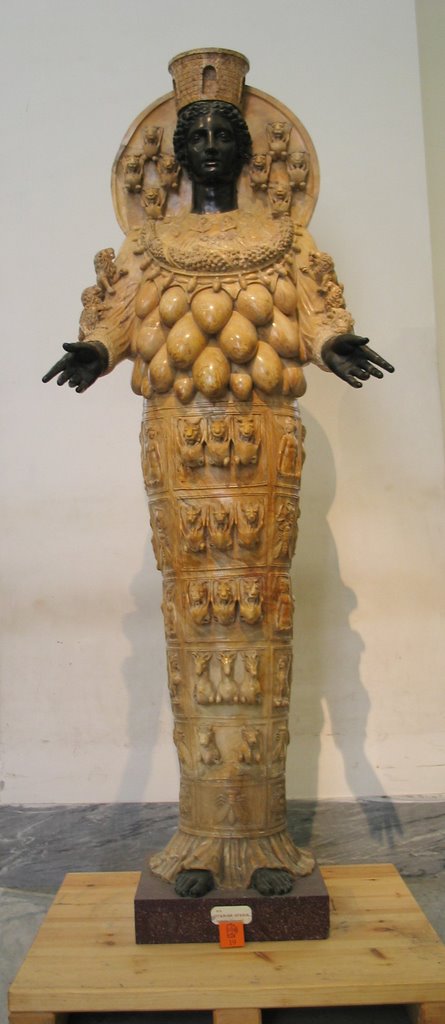
And then there are purely sensory experiences make my life richer. When I go to another city on business, what I do is look at art, because that’s my business. When I go on vacation, I look at art beause that’s my pleasure. Indeed my business and my pleasure are so intertwined that there is no distinction between them, at least in terms of seeing. One thing I can say is that the act of seeing is surrounded by other equally strong sensory perceptions. When I’m walking to the Louvre, I might notice the light at the end of the day; or entering the Accademia in Venice, I might notice the humidity in the air. At the Museo Archeologico in Naples, one of my favorite museums, I enter looking for the statue I love most in the world, knowing I will sit quietly with it for a while, connecting with it in a spiritual way, and then go eat pizza—the authentic stuff— afterward in Spaccanapoli, the old part of town, and then sit in the quiet Cloister of Santa Chiara.

Diana of Ephesis (aka Ma Rhea, aka Diana the Hunter, aka Artemis) personification of strength, creation, life, who was worshipped in Asia Minor before the Christian era. She entered the Christian religion as Mary. She is life size, just under six feet tall, carved of pinkish alabaster, with a cast bronze head and hands. In the folds of her gown she carries animals. On her torso she is weighted down with multiple breasts, though her ethereal presence makes her appear as if she is levitating. Museo Archeologico, Napoli.

So aside from the pleasure of seeing, what I get out of looking at paintings, or art in general, is a general sense of sensory well being—emotion, spirituality, smell, taste, all tied up with what I have seen, where I have been, who I am. And, I don’t know if this is true for "civilian" tourists, but as an artist, the act of taking pictures, and seeing through the lens and recording what I have seen—and lately, Photoshopping what I have shot-- deepens the sensory experience.

Am I an artist because I am a sensory junkie? Isn't that why people get addicted to drugs--because the high is so great, and then their bodies become so dependent on the high that they need the drug just to stay normal? Or am I a sensory junkie because I'm an artist? Maybe we can talk about this topic more in a bit.

But in the meantime, talk to me more about seeing far and wide.

Friday, September 29, 2006

How far back do I look, or, How far afield do I look?

How far back do I look? Very. Now that I think about it, a few weeks later after asking you the question, Joanne, I'm wondering if a better question isn't, "How far to the side do you look? What's your field of vision? How good is your peripheral vision?"

A few stories. It's all about art.

One
I've kind of had it with pro sports. I haven't really been a sports nut anyway since I was about fourteen. But I do like sports. I especially like baseball. And once upon a time baseball really was a pastoral sport. For the spectator, at the game, the action was compact with spaces in between, and long breaks between innings. It's a game you give your attention to in little bits, and between pitches and innings you can comment to your companions, gaze over the crowd, look up at the sky (where instead now flies an airplane trailing a huge banner for a local auto dealer).

But now, and for some time, you go to a game and there is constant entertainment. It's loud all the time. You're never alone with your own thoughts. It's pop entertainment. You really are a spectator far removed from the action because of the artifice surrounding the game: it's harder to hear the crowd; the amounts of money involved are insane; the demographic of the players is far removed from the demographic of the fan. It's basically show biz, but less predictable- they really are playing, though it's not very playful.

Instead, I see much more of the game when I watch college or high school ball. My favorite is to watch women's college softball- intense, fast, high level playing. Even at the high school level the game is fun to watch- the game itself is more open, more porous, closer to an ideal of baseball. There's no money involved and less racket. The pace of the game is more natural because there are fewer distractions to assure me I'm getting my money's worth. But the players still want to do well- they want to win, they want the attention, there's always the dream that some scout is out there.

Somewhere in here is an idea about purity and purpose, about the potential to do something for itself, and for oneself, and for the team. Sometimes you watch a game and things flow- a double play, a player's swing, a beautiful duel between the pitcher and batter, or a moment of blind, intuitive movement of a body in space that turns out absolute, as in the picture of Willie Mays above making the famous over-the-shoulder catch.

Sometimes you see a painting and there are parts where you can see that the painter was in a groove, what Ron Gorchov called, "hallucinatory and difficult to explain." I like seeing that, and even more so, I like experiencing that. I am always looking for that, and it's possible to see it in all kinds of art, even in art that may not really be what one favors. That's the periphery I'm interested in. I am not opposed to, for example, the Leipzig painters, John Currin, Takashi Murakami, and so on... these are names that might go on some people's hit lists, we all have them. But I am not terribly interested in art that wants to act all big league, and tries to distract me with issues and entertainment.

Two
A few years ago I was in the optometrist's office waiting for an eye exam. There were a couple of large paintings on the walls, pastel colors, pictures of little blonde children out in nature, under trees. And they were kind of not so good, but they had enough going on where they were bumping up against being competent.

Rather than read Time or Sports Illustrated, I'd rather stare at paintings. And after a minute I noticed they were signed with the same last name as the optometrist. Turns out, his wife is the painter. And I kept looking.

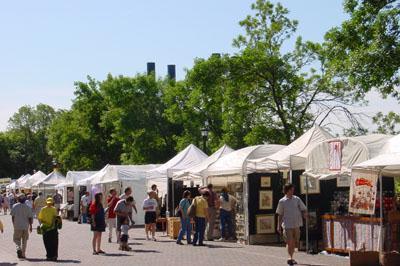
I realized after a couple of more minutes of looking that these paintings were actually quite ambitious, at least compositionally, and the drawing was good enough not to interfere with the painting as a unit. They'd almost just about be passable at one of those wine and art festival things that the Chamber of Commerce likes to put on before Labor Day where women can wear their white dresses and men can wear their polo shirts and khakis and people can come out and see their friends and have a glass of chardonnay and feel cultured and civic minded. Not that there's anything wrong with that.

The wait at this particular office, to which I'd been a few times, can be a little long. That's part of why I don't go there anymore. This particular wait was close to half an hour. I just looked at those paintings, and gave them time, and got involved, and saw how the artist had to get involved, too. I saw her drawing problem, and got attuned to her palette, which although kind of predictable was also very consistent, and really got into her brushstrokes, and how she put on paint. And I could see that, despite the shortcomings of her subject, the predictable colors and the sentiment implied, that this artist was trying to seriously deal with these paintings. I realized that paintings which I wouldn't ordinarily give the time of day to still had a lot to offer if I'd just give them time. And I remember thinking, well, this is kind of like watching little league. The level of play isn't as high, but the game is still there, and I like the game.

Three
Go somewhere where there is a folk art tradition. You're a tourist, and you want to buy a sample. You're going to a central market where you're going to buy a piece of pottery. A painted plate. Let's say you're going to Mexico, to Puerto Vallarta, and you decide to buy a plate, something that you know kind of gets knocked out in production. And you know looking through stacks of these plastes that some of them are painted better than the others. There's a better touch, a nicer line, a little finesse at the end of the stroke, something a little more bold and confident, a feeling that the person who painted it really has a conceptual and physical grasp of the surface of this plate and how to decorate it. I like that.

Four
My grandmother was very supportive of my artistic inclinations. She bought me oil paints when I was eleven, the same day she took me to the Oakland Museum for the first time, during which three things happened.

A: The Oakland Museum has a typical Mel Ramos painting- a nude playmate type astride a brown bear. Certainly, for an eleven year old, I was curious about the nude. And my grandmother didn't want me looking at it. But I knew it was a painting, and that's what really interested me. I don't think she understood the difference, but I did, and I saw, besides his basically puerile subject, that there was some paint going on there. That was a moment.

B: I saw real abstract paintings for the first time. We're talking around 1968, so what I would've seen at this particular museum would've been SF Bay Area AbEx (Still, Corbett, Francis, Hassel Smith, maybe Lorser Feitelson) extending back through to California Surrealism (Helen Lundeberg, blanking on other names) and further back to a kind of late Cubism (Stanton Macdonald-Wright, Lucien Labaudt). And throw in a minimalist kind of thing, like John McLaughlin, a personal favorite. I dug it.

C: After the visit my grandmother took me to a paint store with an art section (RIP Standards Brands paint store) and bought me a set of oils and some canvas paper, and I made my first abstract painting at her house. She would've liked a nice still life, some flowers, but she didn't say so. I liked the paint; it was difficult, but it was a start.

When I paint, I often think back on A, B, and C, and all the other similar experiences and odds and ends in my periphery that have been about looking and paint.

I will write more about the question of how far back do I look, and what has been important to me.

Too Weaks (but I got Ornette!)

Huh? What happened? Did I fall asleep for two weeks? Am I Rip Van Winkle? Did aliens take me away, and then dump me off today, and now I don't know where I've been? Where did the time go? The last thing I know, I make a post "Stay tuned...", and the next thing, here it is two weeks later. Wha'happend?

Day job. I blame my day job. I work full time at a university. And not only do I have a full time day job, I have a new full time day job, with more responsibility. Lot's more. It's not that my days are that much longer, but instead it's the mental energy the job takes that has amped up, and I am woefully behind in all correspondence. I find I am simply not having extra brain power to be verbal all the time. I feel the need to shut off the verbal, which, for a visual artist, is a good thing to do.

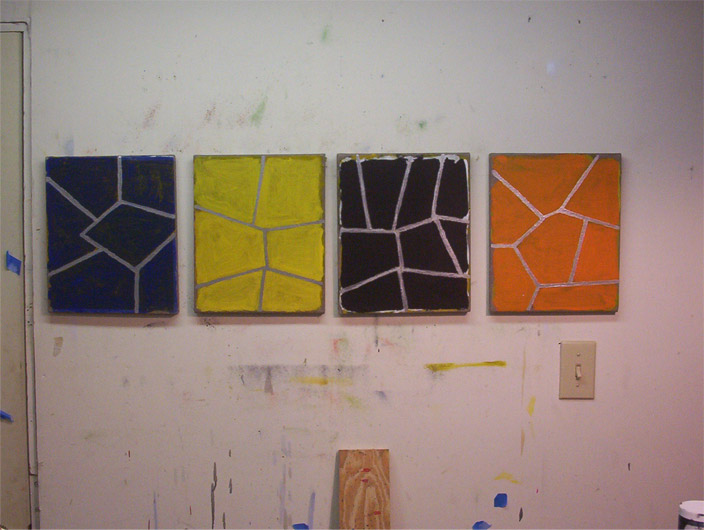
So, I still have time to shut off the verbal. I manage to make an HTML drawing everyday at Look, See. And I have managed to make a small series of four paintings in the past week. They are each titled "Ornette", numbered I-IV. One of these, the orange one, is soon to make it's way across the Pacific to Tokyo for a little group show called Suitcase. More about that soon.


Ornette I-IV, 2006, acrylic and Rust-oleum aluminum on clear acrylic on linen with aluminum tacks, 12 x 10 inches each

"Ornette" refers to Ornette Coleman, who recently said, "Right now, I’m trying to play the instrument,” he said, “and I’m trying to write, without any restrictions of chord, keys, time, melody and harmony, but to resolve the idea eternally, where every person receives the same quality from it, without relating it to some person (http://www.nytimes.com/2006/09/22/arts/music/22cole.html)."

Thursday, September 14, 2006

Stay tuned... and Ron Gorchov


Joanne- I am super busy (aren't we all?) and have not had time to have a clear mind to sit and think and write and respond. But I will.

In the meantime, consider Ron Gorchov with Robert Storr and Phong Bui in the Brooklyn Rail; it's good to see him getting a show at P. S. 1 and the attention he deserves. I remember first seeing a painting of his around 1978 or 1979; it was so good- loose and direct and almost simple, but looking unlike anything else, and feeling very much like a thing unto itself, complete.


Bui: You mean you don’t have a puritanical work ethic like most good Americans?

Gorchov: I hope not. My paintings are mostly made from reverie, and luck...

Storr: ...I wanted you to talk about what it is that makes letting go of a painting so hard, or that makes knowing where you are in the process so difficult to ascertain.

Gorchov: The biggest problem I had with letting paintings go was the feeling that there was an expense to getting a fresh canvas. And if I could make this painting as good as I could make it and keep going with it, however long it took. It’s not rational; I ruined painting after painting to get to a better one. Then I realized that I couldn’t make a painting incrementally better. If you could make it one percent better, maybe, but who cares? A painting has to evolve. With all respect to Myron Stout, I’m not that kind of an artist. Lately, I’m alone in my studio, after the preliminary marks indicate the limits of the elements, I only get one chance. I test the colors that I want, mix them, get the right brushes. I talk to myself—that form will be eight strokes; this form will be 3 strokes—and paint goes down. The next part is hallucinatory and difficult to explain. A decision will be made about adjustments later. Or it will be renovated. Or it feels perfect and can’t be changed.


RON GORCHOV
BATON, 1986
oil on linen
49-1/2 x 37 x 7-1/2"

Thursday, September 7, 2006

Looking: How Far Back, At What, Why


Chris, you ask how far back I look, what I look at, and what I get out of it. The short answer to your first question is that once I leave the 20th and 21st centuries, I look as far back as there's art.
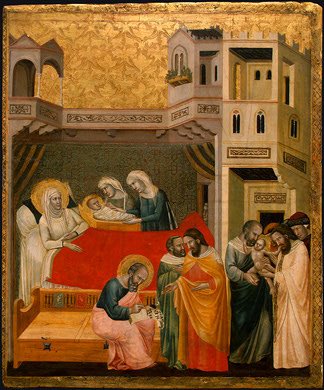
But the more specific answer is that I like Italian early Renaissance painting, particularly Sienese, not so much for the narrative--though
it's endlessly fascinating to see how flat pattern integrates with the beginning of perspective and how the stories are told with the drama of spareness punctuated by detail--but for the color. The particular luminous opacity of tempera on panel, the juxtaposition of colors, and the colors themselves--pink! coral! lime green!--and the veils of translucency, and the gilding.

Simone Martini: tempera and gold on panel, 1328. Sienese, just as Gothic is giving way to the Renaissance


Some of my favorite painters from that time and place are Sano di Pietro, Giovanni di Paolo, Sassetta, and the Master of the Osservanza. (Don't you love how that anonymous painter is not called "anonymous" but given an honorific for his talent and connected to the church where his work is located? He could easily be called the Master of the Coral Hue).


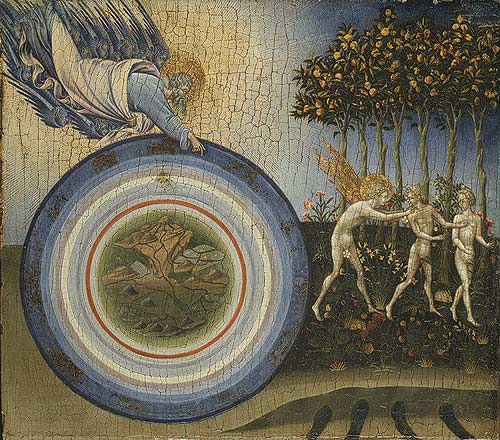
Above, Master of the Osservanza: St. Anthony Tempted by Gold, tempera and gold on panel, 1440. Below, Giovanni di Paolo: The Creation of the World and the Expulsion of Adam and Eve from Paradise, 1445. Sienese.

Color aside, I guess I'm drawn to these two paintings in part because of their degree of abstraction--though I realize I'm looking at them with 21st century eyes. The di Paolo painting, in particular, rocks me to the core every time I visit it at the Met (at the spectacular Lehman Wing). Here, before Copernicus (b. 1473), before Columbus sailed off the edge of the earth and returned to tell about it, di Paolo conceived of a universe in abstract terms. I'm not a historian of art or anything else, but I think some planets had been identified by the mid fifteenth century, and that Dante had already put forth his idea of the Celestial Wheel, but here we see di Paolo's visual conception of the universe as one compact Big Bang.

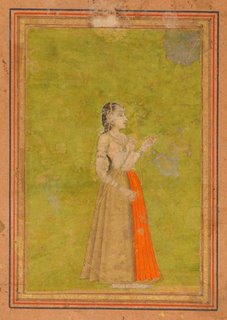
I also love miniature painting from Mughal India and elsewhere in which that tradition was practiced. (I have visited the Morgan Library many times to see illuminated manuscripts, and I'm remembering a show at the Lorenzo di Medici library in Florence in which the manuscripts were encrusted with gems. Gilding the lily for sure.) Here, too, it's the color. But also the scale. Well, the relation of the colors within the scale, and in relation to the scale. These are things I think about in my own painting, too.

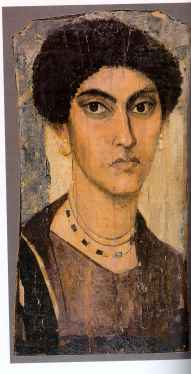
Portrait of a Woman, Mughal India; gouache on paper, Jahangir period, app 1605; 4" high

Farther back, I like to see the Fayum portraits. The Met has five beauties, of which Eutyches, below left, is one. The portraits, which are about life size, are the earliest surviving examples of encaustic painting. Even before I started working in wax, I used to stop by the case in which the portraits are housed. These are portraits of real people, people who looked the artist in the eye as they sat, knowing they would live again in the great Egyptian afterlife and in the meantime remain young forever in their likeness of wax on panel. The Fayums, named after a Nile Delta oasis near where many of the portraits were untombed, were painted in a roughly three-hundred-year period around the cusp between BC and AD, the product of Greco-Roman Egypt. After a sitter's death, the portrait was placed in the wrapped mummy above where the actual face would be, to look out into the world of the great beyond. Talk about multiculture: Greek colonists living in Roman-controlled Egypt, creating portraits to be placed on mummy casings for traditional Egyptian burial rites. I believe the Fayums are the earliest extant paintings made on a portable ground.

From left: Eutyches, at the Metropolitan museum of Art, New York; Isidora at the Getty, Los Angeles; Woman at the National Gallery, London

You realize I'm just scratching the surface here. I might also add Artemisia, not only as a strong painter but as a model of strength against adversity. Giotto, who with the Middle Ages at his back, opened the picture to more a dimensional space.

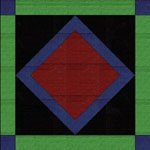
Changing centuries, I also like stuff we would call "ethnic" --Amish and African-American quilts (a la Gee's Bend); Navajo and Hopi textiles; the sculptures of Kuan Yin and mandalas from throughout the East, the Islamic Wing at the Met with its integration of textiles, pottery, caligraphy and architecture.

Clockwise from left: Vajrayana mandala, Mongolia, 19th century; Amish quilt, Lancaster, Pa., 1930's; Zulu telephone wire basket, contemporary; Lola Petway, Bars, 2004, Gee's Bend

Can we make a conceptual leap from di Paolo's universe to the one depicted by the mandala? And a visual one to the mandalas of the basket and Amish quilt? Can we connect the quilts to geometric abstraction from the Sixties to now?

I feel like those actors at the Academy Awards who have to name everyone who ever made a difference in their lives. My agent, my manager. I love you all.

So, what do I get out of all this? As an artist, I find it humbling that what I do, what artists in general do, is pretty much exactly what artists have done throughout history. We daub pigment onto a prepared surface, we handle clay, we stitch cloth, hammer metal, sculpt wood. I know there are 20th and 21st century mediums that don't have the same lineage, but the urge to express, to create, to make manifest is the same urge that the cave painters must have had. So, I guess it's connecting culturally to a world that is not just of this place and to a time that is not just of the present.

Shall we pursue this thread for a bit? Tell me more about what you like to look at.